Technique · 5 min read
How to do a hang 5 (nose manual) on a BMX
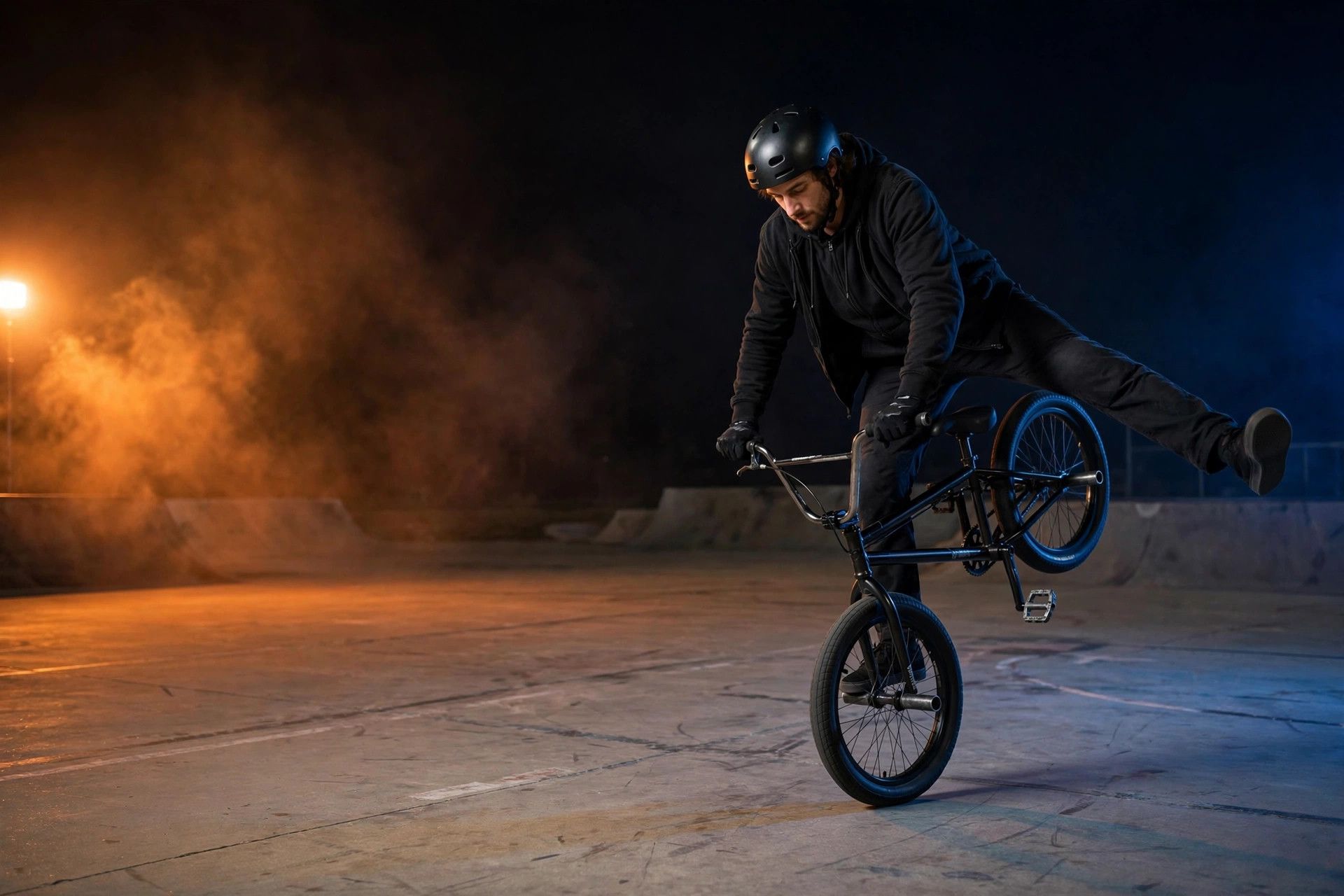
Flatland's nose manual: one foot on the front peg, the other leg hanging, back wheel in the air.
Guide updated
Quick answer: The hang 5 is a flatland nose manual: you balance the bike on the front wheel alone, standing on a front peg with one foot and the other leg hanging. You enter it rolling slowly, weight over the bars and the front brake covered, and it is the first front-wheel balance trick: the gateway to flatland combos.
If you already own the manual and the bunny hop, the hang 5 is the logical next step: instead of balancing on the back wheel, you balance on the front one. One foot on the front peg, the other leg hanging, the back wheel in the air and the whole bike resting on a single point. It is the trick that turns flat ground into a stage: spins, links and almost the whole flatland vocabulary grow out of it.
Before you start
You need a smooth, flat area with no traffic or people around and room to ride in a straight line. The bike needs front pegs fitted tight: without them there is nowhere to put your foot. Check the front brake: it has to respond instantly, because it is your safety net. Wear a helmet and, if you can, gloves: at first the back wheel drops suddenly more than once.
The real requirement is the manual. If you cannot yet hold a manual for a couple of metres with the rear brake covered, the hang 5 will feel impossible: the balance is the same, only the wheel changes. Practise the manual and the bunny hop until they come without thinking, then come for this one.
The hang 5 step by step
- Roll slowly in attack position, with a finger on the front brake lever.
- Shift your weight forward, over the bars, until the back wheel feels light.
- As the back lifts, take one foot off the pedal and place it on the front peg.
- Let the other leg hang extended behind you or to the side, without touching the ground.
- Keep your arms firm and your weight centred over the front wheel; correct with your body, not with yanks.
- To exit, bring the back wheel down gently with a touch of front brake and put your foot back on the pedal.
The key is step two: your weight goes forward and down, over the bars, not by pulling on them. If you stay back, the rear never lifts; if you go too far, you go over the front wheel. Look for the point where the back floats and the front keeps rolling: that is where the trick lives.
Once you are up, balance comes from the whole body: hips, shoulders and knees. Your arms stay firm but not stiff: they carry every correction to the wheel. If you feel yourself tipping forward, a gentle touch of the front brake slows the wheel and the back comes down; if the back drops, load your weight over the bars again. At first you will hold it for a second; then two; then you will cross a line on the ground.
How to get out without crashing
The exit is part of the trick. Don't jump off the peg: touch the front brake gently so the back wheel comes down under control and, as soon as it touches the ground, put your foot back on the pedal. If the back drops hard, bend your arms and legs to absorb it. Practise the exit from day one, even if the balance only lasts a second: exiting well is what lets you try it a hundred times without ending up on the ground.
Tip
Practise at walking pace and in short sessions: the hang 5 tires your arms and your focus, and bad habits creep in with fatigue.
From the hang 5 to the hang 10 and combos
With the hang 5 dialled, the next step is the hang 10: both feet on the front pegs and no leg hanging. It is the same balance with less margin: every correction has to come from your body, because there is no free leg left to act as a counterweight. After that come spins on the front wheel and links into other flatland tricks, which is where the trick becomes a line.
If you want to see how far this world goes, the Viki Gómez piece tells how Spain's most decorated flatland rider built a whole career on flat ground: six world titles and three Red Bull Circle of Balance wins all started, like everything, with a balance on one wheel.
Common hang 5 mistakes
- Going in too fast: at walking pace you find the balance; at speed the back snaps up and you go over the front.
- Leaning back: that is a manual, not a hang 5; your weight goes over the bars.
- Not covering the front brake: without the brake there is no way to bring the back down under control.
- Looking at the ground: your eyes go forward, where you are riding; looking down folds you up and kills the balance.
- Putting the hanging leg down: if the free foot touches the ground, the trick is over: the leg hangs in the air.
- Trying it without owning the manual: the hang 5 is the same balance on the other wheel; without a solid manual there is no base.
Find a skatepark or a smooth plaza to practise and read the skatepark etiquette. Flatland asks for no ramps: it asks for flat ground and hours, and the hang 5 is the first hour that really counts.
Frequently asked questions
What is a hang 5 on a BMX?
A flatland nose manual: riding balanced on the front wheel alone, standing on a front peg with one foot and the other leg hanging, with the back wheel in the air.
What should I know before trying a hang 5?
A solid manual and the bunny hop, plus front pegs and a front brake that responds instantly. Without a manual, front-wheel balance has no base.
Are the hang 5 and the nose manual the same thing?
The nose manual is the family: balancing on the front wheel. The hang 5 is the variant with one foot on the front peg and the other leg hanging; with both feet on the pegs it is the hang 10.
Do I need a front brake for the hang 5?
Yes. It is the trick's control: a gentle touch brings the back wheel down when the balance tips forward, and lets you exit under control.
Can I do a hang 5 without pegs?
No. The supporting foot goes on the front peg, so without pegs there is nowhere to put it.
How long does it take to learn a hang 5?
It varies a lot between people. It usually takes many short sessions at walking pace before you can hold it for several metres in a row.