Buying guide · 7 min
BMX handlebars: the inch that changes your whole bike
Five bars from 7.8″ to 10″ available on Amazon.es: which rise suits your height, which clamp you need and how to fit it.
Guide updated
Quick answer: Choose the rise by your height, then the width by how you ride. As a guide, under 1.60 m an 8.25–8.5″ bar works (KHE Prism 8.25″); between 1.60 and 1.75 m, about 9″ (KHE Prism 9″ chromoly or Odyssey 49er); and over 1.80 m, 9.75–10″ (KHE MVP 10″). For racing or an 18″ bike, the 7.8″ aluminium KHE Prism. Check your stem takes 22.2 mm: all five do.
In this guide
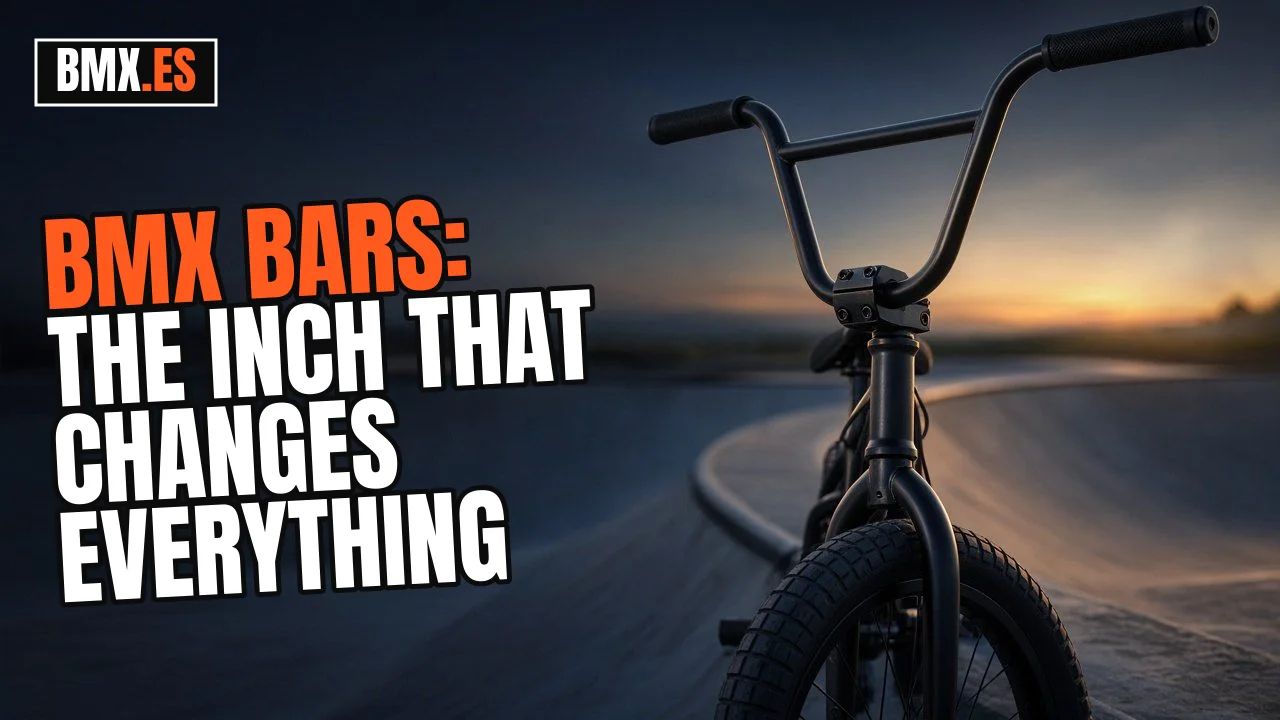
Picture a friend lending you their bike at the skatepark. Same frame, same wheels, but their bars are an inch taller than yours. That inch changes how you stand, how hard you pull to lift the front wheel and how your back feels at the end of the session. BMX handlebars are one of the cheapest parts to change and one of the most noticeable. Here are five, available on Amazon.es on 10 November 2026, sorted from lowest to tallest.
The 5 bars at a glance
Five bars available on Amazon.es on 10 November 2026, from lowest to tallest
198mm
KHE
KHE Prism aluminium 7.8″
- 6061-T6 aluminium
- 640 mm wide
- 440 g
ForRacing and 18″ bikes
210mm
KHE
KHE Prism 8.25″ HiTen (2-piece bar)
- HiTen steel
- 650 mm wide
- 2-piece · 796 g
ForUnder 1.60 m
229mm
KHE
KHE Prism 9″ chromoly (4-piece bar)
- 4130 chromoly
- 736 mm · 10° back
- 4-piece
For1.60–1.75 m, street and park
229mm
Odyssey
Odyssey 49er 9″ (4-piece bar)
- Heat-treated chromoly
- 737 mm · 12° back
- 4-piece
For1.60–1.75 m, built to last
254mm
KHE
KHE MVP 10″ chromoly
- Butted chromoly
- 795 mm · 11° back
- 994 g
ForOver 1.80 m
The figure is the rise in mm, converted from the inches on each listing: 7.8″, 8.25″, 9″, 9″ and 10″. All five use a 22.2 mm clamp.
Some links are affiliate links: we may earn a small commission at no extra cost to you. As an Amazon Associate, BMX.es earns from qualifying purchases (Amazon EU Associates Programme).
What to check, in order of importance
- The clamp. 22.2 mm (7/8″) is the freestyle standard and all five bars in this guide use it. Some race bikes use oversized clamps, as Dan’s Comp notes: check your stem before ordering, because a mismatch cannot be fixed.
- Rise. Measured from the centre of the clamp to the centre of the grip area. It changes the feel more than anything: according to Billet BMX, a tall bar gives more leverage and a more upright stance, and a low one a tighter, quicker front end for street.
- Width. Wider means more stability; narrower, more agility, as KHE puts it. It comes after rise because it usually grows with it.
- Material. Chromoly (4130 CrMo) is the freestyle norm; HiTen steel is the basic option; aluminium weighs far less, and KHE offers it for racing and small bikes.
- Two or four pieces. More about looks and taste than size. KHE describes its 4-piece bar as stiffer.
Which rise suits your height
The bmxsize.com chart is a good starting point for 20″ bikes. It is not a law: more and more riders go taller out of preference, and if you ride hunched over and your back aches, a taller bar lets you stand more upright. On 18″ bikes and smaller, bars are much lower, according to Dan’s Comp.
The 5 BMX handlebars, one by one
We have not tested them hands-on: we compare what makers and shops publish with what each height and riding style needs. The full product cards, with pros and cons, are further down.
1. KHE Prism aluminium 7.8″: for racing and small bikes
6061-T6 aluminium, 640 mm wide, 2° upsweep and 440 g according to the listing: almost half the weight of a steel bar. KHE lists it for 18″, 20″ and race BMX, where every gram at the front counts. Against: low for an adult freestyle rider, and for hard street riding chromoly takes knocks better.
2. KHE Prism 8.25″ HiTen: for shorter riders
Two pieces, 650 mm wide, 210 mm rise and 796 g, in HiTen steel with a knurled clamp area so it does not slip in the stem. It matches the 1.42 to 1.57 m band of the chart. It suits a kid who has grown or anyone who wants a low front end without spending much. Against: HiTen, not chromoly, and too short once you are past 1.60 m.
3. KHE Prism 9″ chromoly: 9 inches without overpaying
Four pieces in 4130 chromoly with butted tubes, 736 mm wide, 10° backsweep and 2° upsweep, at about 1040 g. A 9″ rise fits the 1.63 to 1.73 m band and most street and park riders. Against: a recent listing with few reviews, and the heaviest of the five.
4. Odyssey 49er 9″: built to last
Four pieces in multi-butted chromoly, a 7/8″ crossbar, large-radius bends, welded end caps and heat treatment after welding, according to the Waller BMX listing. It is 29″ (about 737 mm) wide with 12° backsweep and 1.5° upsweep. Same rise as the Prism 9″, with more factory work behind it. Against: the most expensive in this guide, and it may feel low if you are over 1.80 m.
5. KHE MVP 10″: for taller riders
Multiple-butted 4130 chromoly, 795 mm wide, 254 mm rise, 11° backsweep, 2° upsweep and 994 g according to KHE. It is the chart’s size for 1.83 m and up: more leverage and a less bent back. Against: very wide if you are short, and KHE does not allow cutting it down.
If you are X, get Y
| If… | Get |
|---|---|
| You are under 1.60 m | KHE Prism 8.25″ HiTen |
| You race or ride an 18″ bike | KHE Prism aluminium 7.8″ |
| You are 1.60–1.75 m and want to spend little | KHE Prism 9″ chromoly |
| You are 1.60–1.75 m and want durability | Odyssey 49er 9″ |
| You are over 1.80 m or always ride hunched | KHE MVP 10″ |
| Your stem is not 22.2 mm | None: sort the stem first |
Before changing rise, try the bike of someone at your park who runs a taller front end. To find a park nearby, use the skatepark and track directory.
How to change your bars, step by step
- Remove grips and levers, and loosen the stem bolts a little at a time, crosswise.
- Centre the new bar on the knurled section and, to start with, line it up with the fork. Then adjust it to taste in small steps.
- Tighten crosswise to the maker’s torque: KHE gives 10–12 Nm for the MVP 10″.
- Fit grips with plugs and recheck the bolts after your first session.
Before you ride
Never ride bars without end plugs: an open bar end can do serious damage in a fall. If you are changing grips, our BMX grips guide explains how to fit them so they do not twist.
Can I cut my bars down to make them narrower?
Some riders do, but KHE explicitly forbids it on its bars: no cutting or drilling. If a bar is too wide, choose a narrower model. And check the welds now and then for cracks.
Common mistakes
- Ordering bars without checking the stem clamp.
- Jumping from 8.5″ to 10″ in one go: go up gradually.
- Cutting a bar whose maker does not allow it.
- Fully tightening one bolt and then the other, instead of crosswise.
- Riding without end plugs.
With new bars, your manual and bunny hop will feel different: give it a couple of sessions. For the rest of the bike, see the first upgrades guide and all our buying guides.
Frequently asked questions
What rise BMX bars do I need?
It depends on your height and taste. As a starting point, the bmxsize.com chart suggests 8.25–8.5″ under 1.57 m, about 9″ between 1.63 and 1.73 m and 9.75–10″ from 1.83 m.
How is BMX bar rise measured?
From the centre of the area where the stem clamps it to the centre of the grip area.
Will any bar fit my stem?
No. Check the clamp: 22.2 mm (7/8″) is normal in freestyle, and it is what all five bars in this guide use. Some race bikes use thicker sizes.
2-piece or 4-piece bars?
Mostly a matter of looks and taste. A 4-piece bar joins a centre tube, two uprights and the crossbar, and KHE describes it as stiffer.
Can I cut my bars if they are too wide?
It depends on the maker. KHE forbids cutting or drilling its bars; if a bar is too wide, a narrower model is the better choice.