Gear · 9 min read
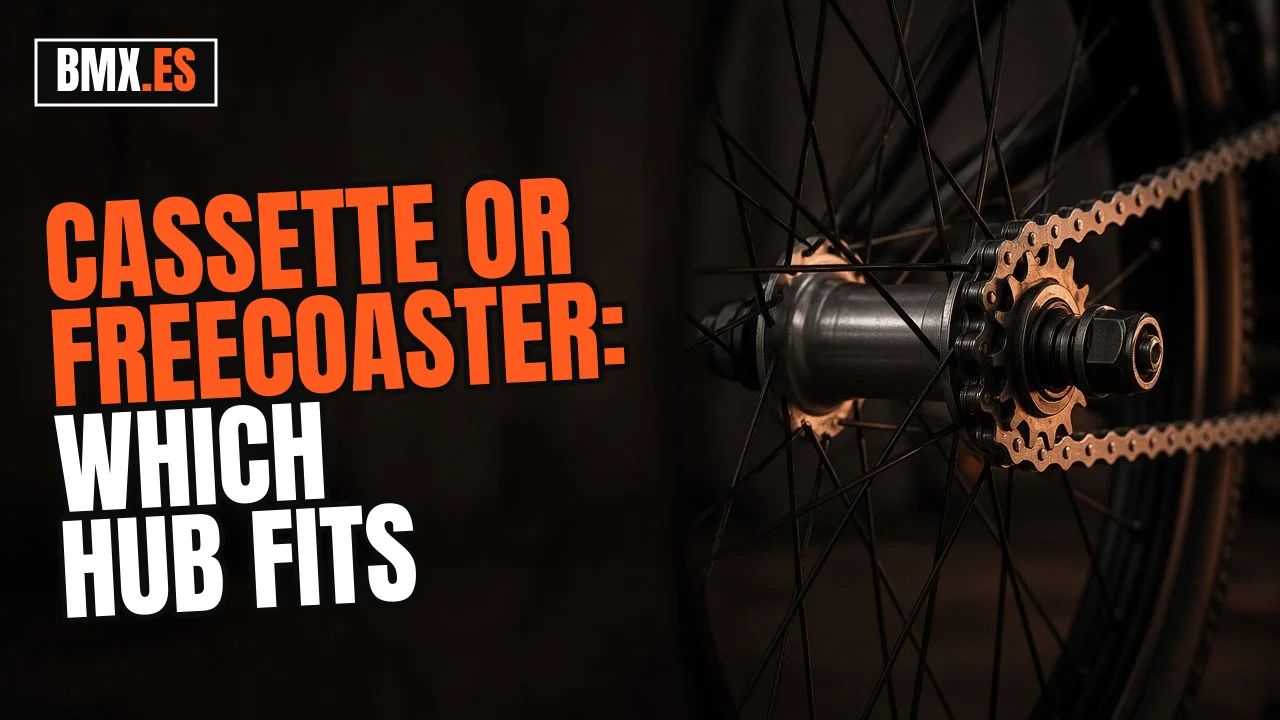
Cassette or freecoaster: the BMX hub that matches how you ride
What changes between a cassette and a freecoaster, which axle and bearings to check, and which one suits you if you ride mostly forwards or in fakie.
Guide updated
Quick answer: If you mostly ride forwards, a cassette hub is the usual choice: on current spec sheets, such as the Odyssey C5 or the KHE ACME slim, a 14 mm rear axle, a 9-tooth driver and sealed bearings come up often. If you spend time rolling backwards, a freecoaster lets the wheel turn backwards without the pedals turning, as KHE explains; many let you adjust that slack, and on the Odyssey Clutch Pro the adjustment is tool-free. Before you buy, check the axle diameter, whether the hub is right- or left-hand drive, and that the bearings match what the listing actually says.
There is a part you barely see that completely changes what happens when you stop pedalling forwards: the rear hub. It is not about which hub is “better”. It is about how you ride. A cassette and a freecoaster do not do the same thing when the bike is rolling backwards, and the wrong axle or the wrong drive side leaves you with a spare that will not fit the frame.
Cassette and freecoaster at a glance
| Cassette | Freecoaster | |
|---|---|---|
| What it does | The driver freewheels when you stop pedalling forwards. It is the type fitted to complete bikes such as the Wethepeople Arcade (Salt Pro cassette hub). | According to KHE, it lets you roll backwards without the cranks or pedals turning. That suits fakie tricks and rolling backwards without having to turn the pedal. |
| Axle (examples) | 14 mm on the Odyssey C5 (chromoly male axle), the KHE ACME slim and the Salt Pro on the Arcade. | On the Odyssey Clutch Pro, current shop listings (Circuit BMX, 5150 BMX) give a 4140 chromoly axle with in-bound 14 mm bolts; they do not state the diameter of the axle body. The Clutch v2, in Odyssey’s official note, is listed with a 14 mm chromoly axle. Always check the listing in front of you: not every generation is the same. |
| Driver (examples) | 9-tooth on the C5, the Antigram v2, the ACME slim and the Salt Pro on the Arcade. | 9-tooth on the Clutch Pro, according to those same shop listings, and also on the Clutch v2. That is not a law for every hub: it is what these listings show. |
| Slack | Not in the freecoaster sense: engagement comes from the driver’s pawls (the Antigram v2, for example, uses three, with independent springs). | KHE talks about adjusting the response and the play in the mechanism. Odyssey calls that slack: on the Clutch Pro it is adjusted with no tools, using a button and rotating the wheel. |
| Drive side | The C5 and the Antigram v2 can be switched from right-hand drive (RHD) to left-hand drive (LHD). | The Clutch Pro is offered in RHD or LHD on those shop listings; so is the Clutch v2, in Odyssey’s note. KHE notes that changing sides usually means replacing the freewheel or other parts, and that it is not the same on every make. |
| Who it suits | Park, dirt, racing, or anyone starting out who mostly rides forwards. | Anyone who already spends time in fakie or on tricks that need to roll backwards without the pedals turning. |
Check this before you order
Axle diameter, whether the hub is RHD or LHD, and the number of holes in the rim (36 in these examples). If those do not match your frame and your wheel, the hub is no use, however well it is made.
What a cassette is
A cassette hub is a rear hub with the cog built into a driver that freewheels when you stop pedalling forwards. It is the set-up on many complete freestyle bikes. The Wethepeople Arcade, for instance, ships with a Salt Pro cassette rear hub, sealed bearings, a 9-tooth driver and a 14 mm axle.
As a spare part, the Odyssey C5 is presented as a cassette with a 14 mm chromoly male axle, a 9-tooth driver that can be set up LHD or RHD, three sealed cartridge bearings and a replaceable plastic hub guard. The Antigram v2, also from Odyssey, uses a 17 mm female axle with 14 mm bolts, a 9-tooth driver with three independently sprung pawls, 6903RS sealed bearings, and can be switched from one drive side to the other; Odyssey lists it at 623 g, with the caveat that weight may vary slightly from batch to batch. The KHE ACME slim is a 36-hole rear hub with a 7005 aluminium shell, a 14 mm 4130 chromoly axle, a 9-tooth driver and sealed industrial bearings.
What a freecoaster is
KHE puts it plainly: unlike a conventional rear hub, a freecoaster lets you roll backwards without the pedal turning. The mechanism allows the wheel to roll in both directions without you having to pedal, which matters for tricks such as fakie. You do not need a freecoaster to learn fakie — the skill is in how to ride fakie — but it changes the feel: the pedals are not forced to follow the wheel.
Many freecoasters let you adjust that slack. KHE describes it as setting the response and the play in the mechanism, sometimes with an Allen key, and treats that kind of adjustment as common today. Odyssey calls it slack: the Clutch v2 already had an external adjuster, and the Clutch Pro does it with no tools, using a button and rotating the wheel forwards or backwards. The Clutch Pro also adds a bearing-equipped drag mechanism, meant for smooth backpedalling and crankflips, a grease port so you can lubricate the hub without taking it apart, and a drive-side guard that, Odyssey says, means you do not have to spread the frame’s dropouts to fit it: spreading them, it says, can be detrimental to the frame’s integrity.
The frame dropouts
If it looks as if you have to spread the dropouts to get the hub in, stop. Odyssey says so with the Clutch Pro: forcing them apart can damage the frame. Better a hub and a guard that fit without being forced, or take the wheel to a shop.
Axle, drive side and bearings
The axle diameter has to match the frame dropouts and, if you run pegs, the inside of those pegs. On the listings in this guide, a 14 mm rear axle comes up again and again: C5, ACME slim, Arcade and Clutch v2. On the Clutch Pro, the shop listings do not give the diameter of the axle body: they do list in-bound 14 mm bolts. At the front, the figures change: the Odyssey C5 front hub uses 3/8″ axle bolts and a chromoly female axle; the KHE ACME front hub lists a “10 mm - 3/8″” axle, 140 mm long; the Salt Pro on the Arcade uses a 3/8″ male axle. Do not assume the front and rear are the same, or that 10 mm and 3/8″ are interchangeable on every model: on the front ACME the maker lists them as the same size, and other listings show only one of the two.
RHD and LHD, according to KHE, tell you which side the freewheel sits on relative to the chain, looking at the bike from behind: the right or the left. The chain has to run on that same side. Some listings, such as the C5 and the Antigram v2, let you switch sides. On other hubs, KHE writes, going from one to the other usually means replacing the freewheel or other parts, and how hard that is depends on the model.
Sealed bearings (cartridge or “industrial”, in KHE’s and Odyssey’s wording) are what all of these listings use. KHE recommends cleaning them and regreasing them regularly so the hub lasts and rolls smoothly. The Clutch Pro, with its grease port, is designed so you can lubricate it without opening the hub. If your hub still uses cones and loose balls, KHE has a workshop on how to set them: that is not the same job as a sealed cartridge.
If you ride forwards Park, dirt or the race track: a cassette fits that use and is what many complete bikes come with.
If you ride fakie A freecoaster lets the wheel roll backwards without turning the pedals. Learn the movement first; then decide whether you need the hub.
If you are swapping the hub Write down the axle, RHD or LHD, and the rim’s hole count. Without that, do not order.
If you are just starting You do not need a freecoaster in the first month. Getting the bike right and actually riding matters more: that is in the first BMX guide.
The hub is one of the first upgrades people consider, but not the first: pedals, tyres and grips are noticeable sooner. If you are also changing the chain or the sprocket, see the chain guide. And if pegs share that same axle, check the size in the pegs guide.
The examples behind the figures
These are not a shopping list or a ranking. They are the manufacturer listings used for the measurements, so as not to talk about the hub in the abstract. On the Clutch Pro, the axle-body diameter and the driver tooth count do not appear in Odyssey’s official note: those two figures come from shop listings.
- Odyssey C5 cassette: 14 mm chromoly male axle, 9-tooth driver that can be set up LHD or RHD, three sealed cartridge bearings, replaceable plastic guard. The C5 front hub uses 3/8″ bolts, a chromoly female axle, sealed bearings and two plastic guards.
- Odyssey Antigram v2 cassette: 2014-T6 aluminium shell, 14 mm bolts and a 17 mm 4130 chromoly female axle, 9-tooth driver with three pawls, 6903RS sealed bearings, switchable LHD/RHD, 623 g (Odyssey notes that weight may vary between batches).
- KHE ACME slim (rear): 36 holes, 7005 aluminium, 14 mm axle 165 mm long in 4130 chromoly, 9-tooth driver, sealed industrial bearings, 1.11 lb.
- KHE ACME (front): 10 mm / 3/8″ axle, 140 mm long, sealed industrial bearings, 234 g, 36 holes.
- Wethepeople Arcade (complete): Salt Pro cassette rear hub, sealed, 9-tooth, 14 mm axle, 36 holes; Salt Pro sealed front hub, 3/8″ male axle, 36 holes.
- Odyssey Clutch v2 freecoaster: 14 mm chromoly axle, 9-tooth driver, RHD or LHD, 36 holes, external slack adjustment, optional plastic guard.
- Odyssey Clutch Pro freecoaster: in the official note, tool-free slack adjustment, grease port, bearing-equipped drag mechanism and a drive-side guard designed so you do not have to spread the dropouts. On Circuit BMX and 5150 BMX listings: 9-tooth driver, RHD or LHD, 4140 chromoly axle with in-bound 14 mm bolts, 36 holes.
Common mistakes when choosing a hub
- Ordering a freecoaster “just in case” in the first month. If you are still riding forwards, a cassette covers that. A freecoaster makes sense once fakie is part of how you ride.
- Not checking the axle. A 14 mm axle will not fit dropouts meant for another size, and neither will the pegs.
- Mixing up RHD and LHD. The chain has to match the driver’s side. On some hubs you can switch; on others it is not a simple flip.
- Spreading the dropouts to get the hub or the guard in. Odyssey advises against it.
- Forgetting the rim’s hole count. These examples are 36-hole; if your rim is different, a loose hub will not work without rebuilding the wheel.
Once the hub is yours, a little maintenance — cleaning and greasing, as KHE puts it — helps it last. And if you are still choosing the whole bike, start with how to choose your first BMX.
Frequently asked questions
Cassette or freecoaster if I am just starting?
A cassette covers the usual first use, which is riding forwards, and it is what complete bikes such as the Arcade come with. A freecoaster makes sense once you already spend time in fakie and want the pedals not to turn when you roll backwards.
Do I need a freecoaster to ride fakie?
No. You can learn it on a cassette, timing the spin of the pedals. A freecoaster, according to KHE, lets you roll backwards without them turning. The skill is in the fakie guide; the hub is a separate decision.
What axle size do I need?
The size of your frame dropouts, not a “universal” size. On the listings in this guide the rear axle is 14 mm and the front is 3/8″ (the front ACME also lists that as 10 mm). Check your own bike before you order.
What is the slack on a freecoaster?
It is the play before the mechanism engages when you pedal forwards. KHE talks about adjusting the response and the play; Odyssey calls that slack. On the Clutch Pro you change it with no tools, by rotating the wheel.
What do RHD and LHD mean?
Right-hand or left-hand drive: which side the driver sits on relative to the chain, looking at the bike from behind, as KHE explains. It has to match your frame. Some hubs, such as the C5 or the Antigram v2, can be switched; on others the change is more involved.
Can I go from a cassette to a freecoaster in the same wheel?
Only if the new hub has the same hole count as the rim (36 in these examples) and the axle and drive side match the frame. It is not a bolt-on swap: you are rebuilding the wheel or buying a wheel already built. If you have not done that before, a shop will get it right.
Sources
- Odyssey — C5 cassette and front hub
- Odyssey — Antigram v2 cassette
- Odyssey — Clutch v2 freecoaster
- Odyssey — Clutch Pro freecoaster
- KHE — What a freecoaster is (innovations)
- KHE — BMX Hubs
- KHE — ACME slim (rear hub)
- KHE — ACME (front hub)
- Wethepeople — Arcade
- Circuit BMX — Clutch Pro (shop listing)
- 5150 BMX — Clutch Pro (shop listing)
- Strictly BMX — C5 cassette (shop listing)
- Source BMX EU — Antigram v2 cassette (shop listing)