Gear · 7 min read
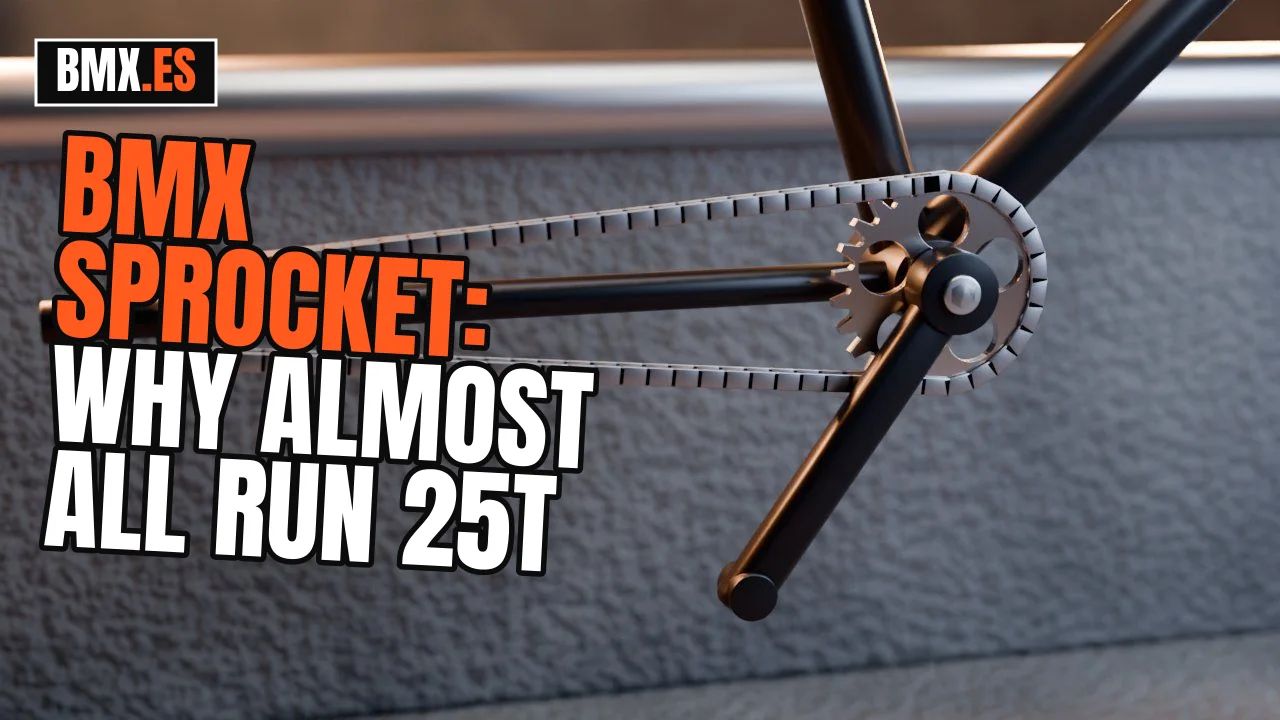
BMX sprocket: why almost everyone runs 25 teeth
Why 25/9 is the standard, when to go up to 28 teeth, which spindle and adapter to check and four 25-tooth sprockets on Amazon.es, with step-by-step fitting.
Guide updated
Quick answer: Almost every freestyle BMX runs a 25-tooth sprocket with a 9-tooth driver (25/9): the rear wheel turns 2.78 times per crank turn, and the small sprocket gets in the way less on grinds. For an easy swap, the steel KHE MVP (78 g) or the aluminium KHE MVP (54 g); the Eastern Phorcys comes with an adapter and rounded teeth, and if your cranks have a 48-spline spindle, the KHE Spline Drive needs no drive bolt. Go up to 28 teeth only if you want more top speed.
In this guide
Count the teeth on the sprockets at your local park: almost all of them have 25. It is not chance or a fad. It is the number that keeps the bike pedalling much like BMX bikes always have, but with a small sprocket that hits ledges and rails less. Here is why a 25-tooth BMX sprocket is the standard, when it makes sense to change it, and four sprockets available on Amazon.es on 16 November 2026.
The 4 at a glance
Four 25-tooth sprockets available on Amazon.es on 16 November 2026
78g
KHE
KHE MVP 25T steel (sprocket)
- HiTen steel
- 23.8 mm bore
- 7 colours
ForA no-fuss replacement
54g
KHE
KHE MVP 25T aluminium (sprocket)
- 7005 aluminium
- 5 mm
- 24 mm bore
ForSaving weight
60g
Eastern
Eastern Phorcys 25T (sprocket)
- Forged 6061 aluminium
- Adapter included
- Rounded teeth
ForNo separate adapter
98g
KHE
KHE Spline Drive 25T (sprocket)
- 48 splines
- 7.9 mm
- 19 mm spindle
For48-spline cranks
The figure is the weight in grams from each listing (for the Eastern, 2.1 oz converted). All four are 25-tooth.
Some links are affiliate links: we may earn a small commission at no extra cost to you. As an Amazon Associate, BMX.es earns from qualifying purchases (Amazon EU Associates Programme).
Why almost everyone runs 25 teeth
Profile Racing tells the story: in 2003 it released a 9-tooth driver (the cog on the rear hub), and the usual combination dropped from 36/13 to 25/9. It has been the freestyle standard ever since.
The maths is simple: sprocket teeth divided by driver teeth. According to BMX Gear Calculator, 25/9 gives 2.78, almost the same as the 44/16 (2.75) people raced on in the 80s. In other words, the bike pedals the same as back then, but with much smaller parts.
25 or 28 teeth?
With 28 teeth and the same 9-tooth driver, the ratio goes up to 3.11: 12% more gear. BMX Gear Calculator sums it up: more top speed, but harder to get going. The other way round, a 23/9 (2.56) is easier to start and is suggested for younger riders. Profile adds one more reason to go up: some riders choose 28/9 because it suits sprocket tricks better.
If you ride technical street, ledges and rails, stay on 25. If you mostly ride bowls, big ramps or dirt and run out of speed, try 28, knowing you will need to adjust the chain. Before spending, ask someone at your park to let you try their bike: here is the directory of skateparks and tracks.
What to check before you buy
- The teeth. 25 if your driver has 9 and you want standard gearing. Check how many teeth your driver has: it is on the hub’s spec sheet.
- Your crank spindle. The bolt-on sprockets in this guide have a bore of about 24 mm. For a 19 or 22 mm spindle you need an adapter ring: KHE sells both, and the Eastern includes one.
- Bolt or splines. A Spline Drive sprocket only works if your cranks have a 48-spline spindle.
- The material. HiTen steel for a tough, simple replacement; aluminium to save weight.
- The chain. BMX sprockets take a 1/8″ chain: if in doubt, see the BMX chain guide.
The 4, one by one
We have not tested them in hand: we compare what makers and shops publish with what each rider needs. The full product cards, with pros and cons, are further down.
1. Steel KHE MVP 25T: the no-brainer replacement
HiTen steel, 25 teeth, 78 g, 23.8 mm bore and compatible with 1/2″ × 1/8″ chains, according to KHE, which lists it as suitable for every freestyle BMX. It comes in seven colours. Against: heavier than the aluminium ones and, with a 19 or 22 mm spindle, the adapter is sold separately.
2. Aluminium KHE MVP 25T: the light one
CNC-machined 7005 aluminium, 5 mm thick and just 54 g, the lightest in this guide. 24 mm bore; KHE says it fits 19 mm spindles with an adapter ring. Against: at 5 mm it is much thinner than the Spline Drive (7.9 mm), and the adapter is not included either.
3. Eastern Phorcys 25T: adapter included and rounded teeth
Forged 6061 aluminium, then CNC-machined, about 60 g (2.1 oz) and a 15/16″ bore with an adapter included to fit most BMX cranks, according to its Amazon.es listing. The teeth are rounded so the sprocket and chain last longer. Against: the listing does not give the thickness, and Amazon notes it is a UK import.
4. KHE Spline Drive 25T: no drive bolt
7005 aluminium, 7.9 mm thick and 98 g, with a 48-spline steel insert: the crank spindle drives the sprocket directly and no drive bolt is needed, KHE explains. It fits 19 mm, 48-spline spindles. Against: if your cranks do not have those splines, it will not fit; and it is the heaviest of the four.
If you are X, get Y
| If… | Get |
|---|---|
| You bent your sprocket and want a steel replacement | Steel KHE MVP |
| You want to save weight | Aluminium KHE MVP (54 g) |
| You do not want to buy the adapter separately | Eastern Phorcys |
| Your cranks have a 48-spline spindle | KHE Spline Drive |
| You ride bowls or dirt and lack speed | A 28-tooth (and adjust the chain) |
How to change your sprocket, step by step
- Take off the crank arm on the chain side.
- Swap the sprocket, with its adapter ring if your spindle is 19 or 22 mm.
- Refit the crank and tighten. KHE gives 8–10 Nm for its bolt-on sprockets, and 5–8 Nm for the Spline Drive.
- Set the chain tension: the step-by-step is in how to tighten a BMX chain.
Before you ride
Recheck the bolts after the first session. KHE says to replace the sprocket as soon as you see uneven wear, cracks or damage.
If I go from 25 to 28 teeth, can I keep the same chain?
A bigger sprocket needs more chain. Moving the wheel back in the dropouts may be enough; if not, you will have to add links. See the BMX chain guide, which covers the half link.
Common mistakes
- Buying a sprocket with a 24 mm bore for a 19 mm spindle and forgetting the adapter.
- Buying a Spline Drive for cranks without splines.
- Going up to 28 teeth without checking the chain length.
- Changing the sprocket and not re-tensioning the chain.
- Tightening by feel: the torque is on the maker’s spec sheet.
To carry on with the drivetrain, see the hub: cassette or freecoaster, the first upgrades and all the buying guides.
Frequently asked questions
How many teeth should a BMX sprocket have?
In freestyle, 25 with a 9-tooth driver is the standard: according to BMX Gear Calculator it is by far the most popular combination. 28 teeth gives more top speed and 23 an easier start.
What does 25/9 mean?
A 25-tooth sprocket and a 9-tooth driver. Divide them and you get 2.78: for every crank turn, the rear wheel turns 2.78 times.
Why do BMX bikes no longer have big sprockets?
Because in 2003 Profile released a 9-tooth driver and the sprocket could drop from 36 to 25 teeth with almost the same gearing. A small sprocket is lighter and gets in the way less on grinds.
What is a Spline Drive sprocket?
A sprocket with a 48-spline insert that slides straight onto the crank spindle, with no drive bolt. It only works if your cranks have that spindle; the KHE one is for 19 mm spindles.
Do I need a sprocket adapter?
If the sprocket bore is about 24 mm and your crank spindle is 19 or 22 mm, yes. KHE sells adapters for both spindles, and the Eastern Phorcys includes one.