Learn · 6 min
How to do a 180 on a BMX: a step-by-step guide for beginners
The first freestyle spin: a bunny hop with a half turn and a fakie roll-out.
Guide updated
Quick answer: The 180 is a bunny hop where you spin half a turn in the air and land rolling backwards (fakie). The key is not in your legs: your head and shoulders lead the spin. Just before you jump, “wind up” by turning slightly the opposite way, and as you take off, turn your head and shoulders towards where you want to look; the bike follows your body. Land on both wheels together, cranks level, and keep rolling fakie for a few metres before riding out.
The 180 is the first spin you learn in freestyle BMX: a bunny hop that turns half a revolution. If your bunny hop is not solid yet, this is not your article yet: the 180 is built on top of it. Start with how to manual and bunny hop and with the attack position.
Before you start: what you need first
- A basic, consistent bunny hop. It does not need to be high, but it must take off and land on both wheels together without you thinking through each phase. If your bunny hop only works “sometimes”, your 180 will work “almost never”: automate the hop first.
- Rolling fakie, even just a little. When you land the 180 you will roll backwards. Practise the feeling first: find a gentle slope or the lip of a ramp, roll up forwards, let the bike come back down and roll a few metres fakie, pedalling backwards at the wheel’s pace without grabbing the brake. Holding a few metres is enough to start.
- Knowing how to ride out of fakie (even if it is ugly). The basic exit: keep rolling fakie, turn the bars in the direction of the spin and give half a pedal forwards, leaning on the pedal; the front wheel pivots and you are rolling normally again. Early on, putting a foot down and turning by hand also counts: what matters is not getting stuck facing backwards.
Safety and spot
- A helmet always, and if you are starting out, shin pads: on the first attempts the bike spins and the pedals hunt your shins. The BMX protective gear guide covers the rest.
- The ideal spot is the same as for the bunny hop: a wide, smooth, flat area with no traffic and nobody crossing, because when you land facing backwards you cannot see what is behind you. An empty open space or the flat area of a skatepark first thing in the morning. If you practise in a shared park, read the skatepark and track etiquette and let people know you are practising spins.
- Check first that the bars do not twist against the wheel and that the bolts are tight: the 180 punishes the steering more than riding in a straight line.
The flat-ground 180, step by step
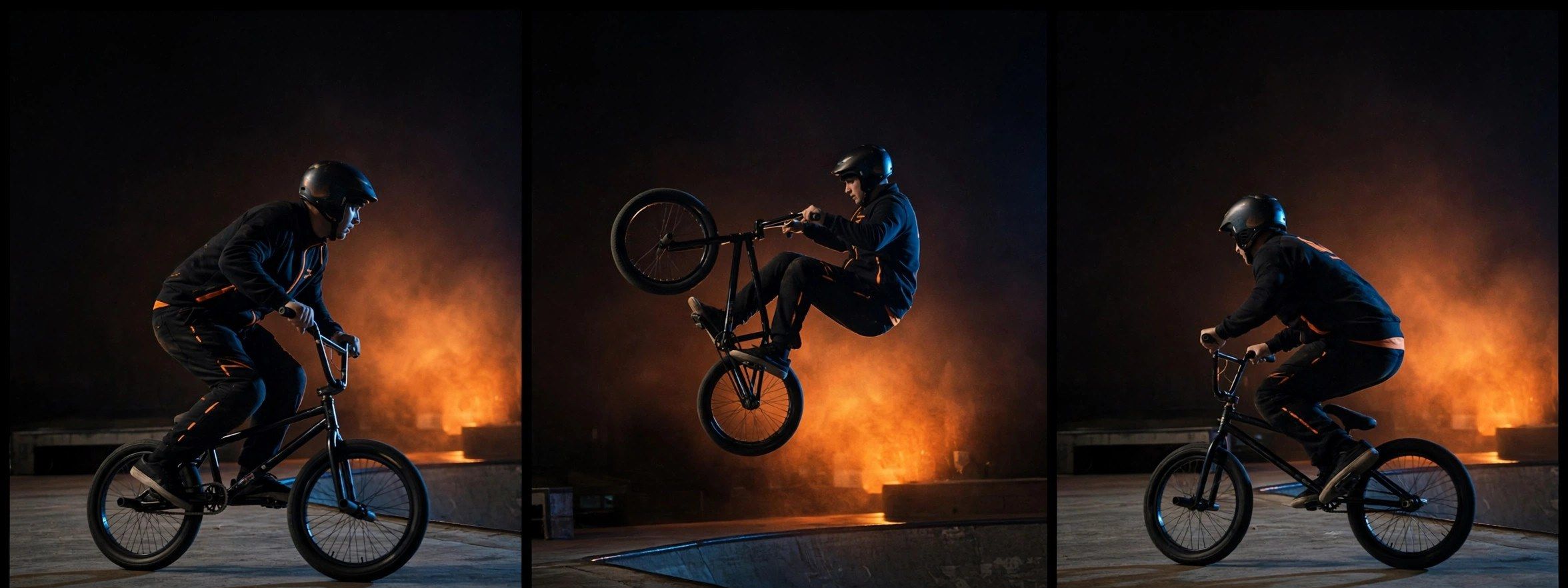
- Roll at a gentle, steady speed in the attack position, cranks level, with your good foot forward. Not too slow (no momentum and the spin stalls) and not fast (you cannot control the fakie afterwards yet).
- “Wind up” your body: just before you jump, turn your head, shoulders and hips slightly towards the opposite side to the one you will spin to, like loading a spring. It is a short move, not a full turn.
- Bunny hop and spin at the same time: as you take off, turn your head and shoulders decisively towards your natural spinning side (the one that feels comfortable when you try it without the bike, jumping on the spot) and look where you want to land. Your body drags the bike round: if you look, it spins; if you look at the ground, it stops halfway.
- In the air, bring your hips round and keep the bike tucked up by bending your legs, as in the bunny hop. Do not try to “pull” the bike round with your arms: your arms hold the bars, your trunk does the spin.
- Land on both wheels together, arms and legs bent and absorbing, cranks level. Your eyes are already looking in your new direction (backwards relative to where you came from).
- Keep rolling fakie for a few metres, pedalling backwards gently, then ride out with the half pedal and bar turn. Do not try to exit the instant you land: stabilise first, then exit.
Honest expectations: your first attempts will be 90° spins, or half-finished 180s with a foot down. That is the normal progression. A good intermediate drill is practising the spin with barely any jump: very low bunny hops exaggerating the head turn, or pivoting on the rear wheel by lifting only the front (a pivot) to learn which way your body spins.
Next: the 180 off a kerb or a small ramp
When your flat 180 works most of the time (you land and ride out of fakie without putting a foot down), add a little help:
- Off a low kerb or the edge of a gentle ramp: the small boost and extra airtime make the spin easier than on flat. Roll in slowly, make the same move (wind up, turn head and shoulders, look) and land on the flat, not inside the ramp at first.
- Do not raise the height before the consistency: a clean 180 off a low kerb is worth more than a forced one off something tall, where fear makes you stop looking and the spin stalls.
Common mistakes when learning the 180
- Spinning only with your arms or the bars: the bike turns 45° and stops. The spin starts in your head and shoulders; your eyes lead it.
- Not winding up before the jump: without loading the spin the other way, you run out of rotation in the air and stall at 90°–135°.
- Looking at the front wheel or the ground: your body locks up and the spin cuts short. Look where you want to go, as in the attack position.
- Taking off too slowly: without a minimum of speed, when you land facing backwards you stop dead and fall sideways. Keep a gentle but committed speed.
- Trying to exit the fakie the moment you land: roll a few metres and stabilise first; the exit comes by itself once the fakie is calm.
- Wanting the 180 before the bunny hop: the underlying mistake. If the base hop is not automatic, the spin has nothing to build on; go back to the bunny hop guide for a few sessions.
Find an open space or a nearby skatepark in the directory to practise with room.
What comes next
- Confident fakie: rolling further backwards and exiting cleanly is half the trick; many riders train it separately by rolling up a ramp and coming back down fakie.
- The 180 on a ramp: the same move out of a ramp or a gentle quarter, with more airtime. It comes once the flat one is automatic.
- Linking it up: a 180 into fakie and another spin to ride out (half turn + half turn) is the basis of simple flat-ground lines.
Frequently asked questions
What do I need before learning the 180 on a BMX?
A basic, consistent bunny hop and the ability to roll a few metres backwards (fakie). The 180 is a bunny hop that spins half a turn and lands fakie, so without those two bases the trick will not work.
Which way do you spin a 180?
Towards your natural side: the one that feels comfortable when you spin jumping on the spot without the bike. Most riders spin towards their front foot, but it is not a rule; try both in gentle attempts and keep the one your body does without thinking.
Why do I stall halfway round?
Almost always because of your eyes: if you do not turn your head and shoulders and look where you want to land, your body locks up and the bike stalls at 90°–135°. Winding your body up the opposite way just before take-off also helps.