Technique · 4 min read
Dave Mirra: the "Miracle Boy" who brought BMX into the living room
24 medals, the first double backflip in competition and a video game with his name: the Miracle Boy legacy.
Guide updated
Quick answer: Dave Mirra (1974-2016) was the rider who took BMX freestyle out of the parks and into the living room: 24 X Games medals (14 gold) between 1995 and 2009, the first double backflip ever landed in competition (San Francisco, 2000), two video games carrying his name, and a city, Greenville, turned into the unofficial freestyle capital of the world.
There was a time when BMX was never on TV, had no video game of its own, and was unknown to anyone outside the parks. That time ended with a kid from Chittenango, a small town in New York state, who had a sponsor at 13 and would go on to win 24 X Games medals. His name was Dave Mirra, and if BMX freestyle is what it is today, it owes a large part of that to him.
Numbers that took years to match
Mirra turned professional in 1992 and, from the very first X Games in 1995, never left the podium: he won at least one medal at every edition until 2009, except 2006, when an injury kept him out. In total he collected 24 medals, 14 of them gold, competing in park and vert. His total medal count was the X Games record until 2013, and his 14 golds are still the second-best haul in Summer X Games history, behind only Shaun White's 15.
He was no one-trick specialist: he would win in park one year and in vert the next, and in 1998 he even took gold in doubles vert. That consistency over fifteen years, more than any single trick, is what sets him apart from the other legends.
The double backflip that rewrote the script
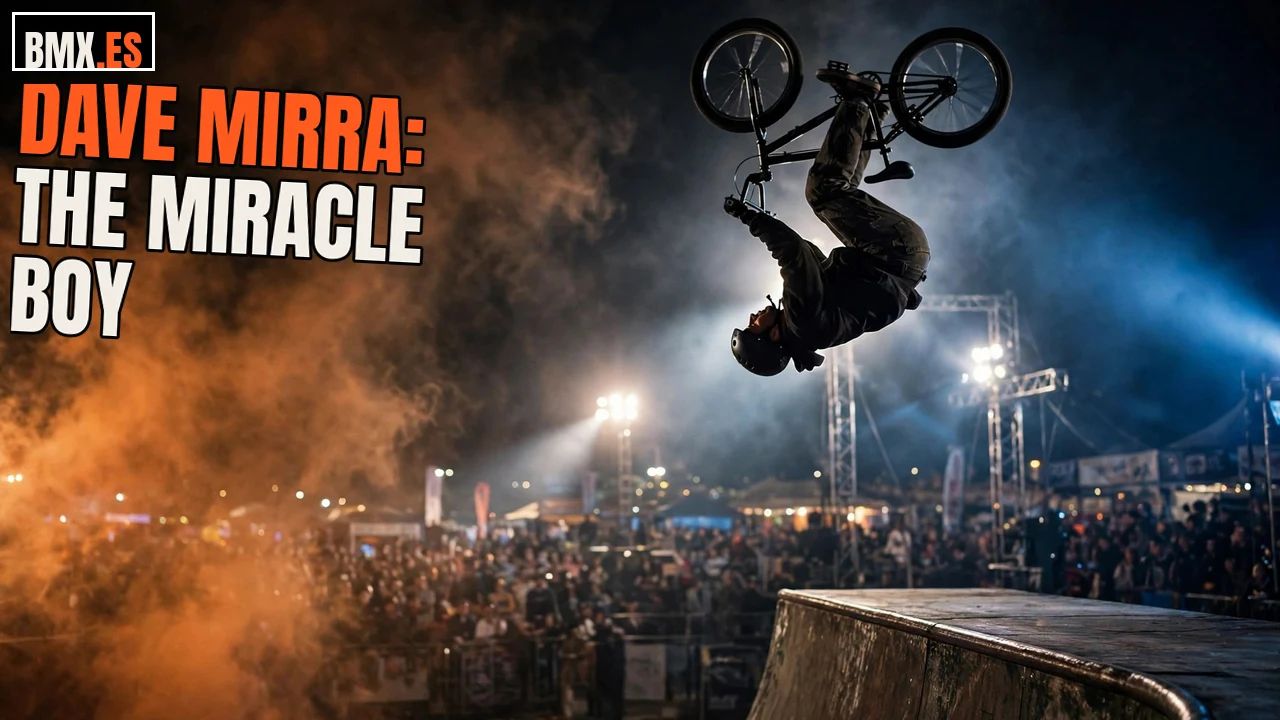
At the San Francisco X Games in 2000, Mirra landed the first double backflip in competition in BMX history. Until that day, spinning backwards twice on a 20-inch bike was one of those things riders talked about as impossible around the parks. After that day, it became the trick every professional had to have in their run.
The nickname came earlier — "Miracle Boy", for his habit of saving tricks that looked lost — but that double backflip turned him into "Miracle Man" and into the visible face of the sport for everyone who did not ride. If spins make you curious, start with the base: the 180 and the 360 are the steps that come before any full flip.
BMX walked into people's homes: TV, video games and even kids' menus
Mirra was the first rider who truly crossed over to the mainstream. He hosted two seasons of an MTV reality show, appeared on American late-night television, and in 2000 starred in his own video game, Dave Mirra Freestyle BMX, which was followed by a sequel: for a whole generation, the first BMX they ever touched was the one in that game.
And he reached a place no rider had reached before: in 2001, Burger King launched its X-Stunt Sport Sets in the United States and Canada, extreme-sports toys for its kids' menus, and the TV advert for the campaign, titled "Burger BMX", starred Dave Mirra alongside names such as Ryan Nyquist. Today it sounds like a footnote, but in 2001 it meant BMX was already popular culture: a kid could never have seen a park and still know who Mirra was.
Greenville, MirraCo and the second life
Mirra settled in Greenville, North Carolina, and the city filled with professionals moving there to train with him: for years, Greenville was the unofficial world capital of BMX freestyle. In 2005 he founded his own brand, MirraCo, whose bikes Trek distributed for eight years. If today you pick a brand and a geometry with our BMX frame guide in hand, it is partly because riders like him turned equipment into part of the show.
He retired from BMX competition in 2011, but he did not sit still: he raced rallycross with Subaru's official team in the United States (fourth in the 2013 championship) and moved on to long-distance triathlon, with several Ironman finishes and a team win at the 2014 Race Across America. The pattern was always the same: if there was a wall, Mirra tried to go through it.
A sad ending and an intact legacy
Dave Mirra died on 4 February 2016 in Greenville, aged 41. His death hit the whole sport and opened a necessary conversation about head impacts and mental health in extreme sports, one that continues today. That same year he was inducted, posthumously, into the US BMX Hall of Fame.
His legacy needs no exaggeration: 24 medals, the first double backflip in competition, a video game with his name on it, and a whole generation who started riding because they saw him on TV. When a kid lands their first trick at a skatepark today, they do it in a sport Mirra helped to build. And if that first trick is going to be a spin, the tailwhip is one of the tricks he made mandatory in every run.
This is the first instalment of "BMX Legends". The next one looks at the present: Viki Gómez, the Spanish flatland rider still reaching podiums at 45.
Frequently asked questions
How many X Games medals did Dave Mirra win?
24 in total, 14 of them gold, between 1995 and 2009. It was the X Games medal record until 2013.
Which trick made Dave Mirra famous?
The double backflip at the San Francisco X Games in 2000: the first one ever landed in competition in BMX history.
Did Dave Mirra have a video game?
Yes, two: Dave Mirra Freestyle BMX (2000) and its sequel, published by Acclaim. They were the gateway into BMX for much of the 2000s generation of riders.