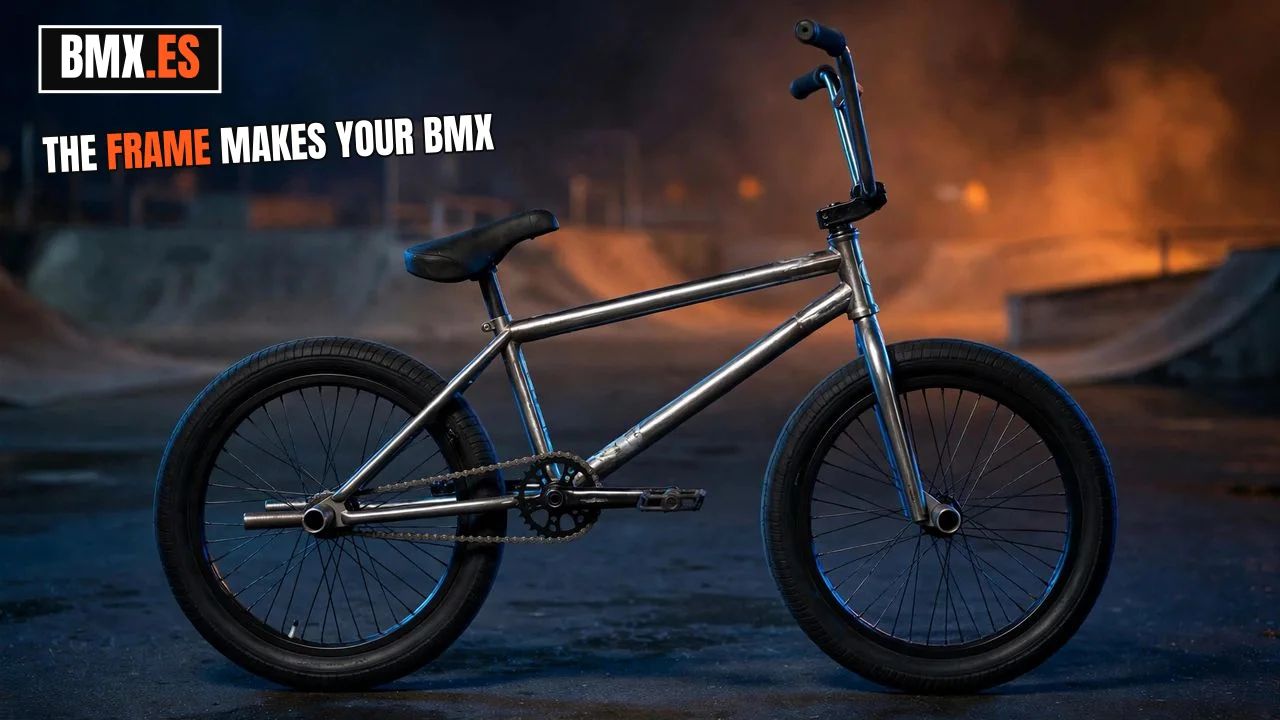
Gear · 9 min read
How to choose a BMX frame: geometry, material and size
The geometry you feel when you ride, the material that lasts and the size for your height, with the details to check before paying.
Guide updated
Quick answer: Pick a frame by top tube length for your height — 20.5" to 21.25" for most adults — with short chainstays for tech riding and long ones for stability, and in full 4130 chromoly if you are going to ride it hard: hi-ten only makes sense to start cheap or on kids’ bikes. Before paying, check the dropouts, the integrated headset and that the brakes are removable.
The frame is the part you never change: everything else — fork, stem, wheels — can be replaced, but the geometry you buy is the geometry you ride. So it is not chosen by colour or by the rider whose name is on it, but by four measurements and one material. This guide follows that order: first the geometry you feel when you ride, then the material and the size, and finally the details you check in two minutes before paying.
The geometry, in four numbers
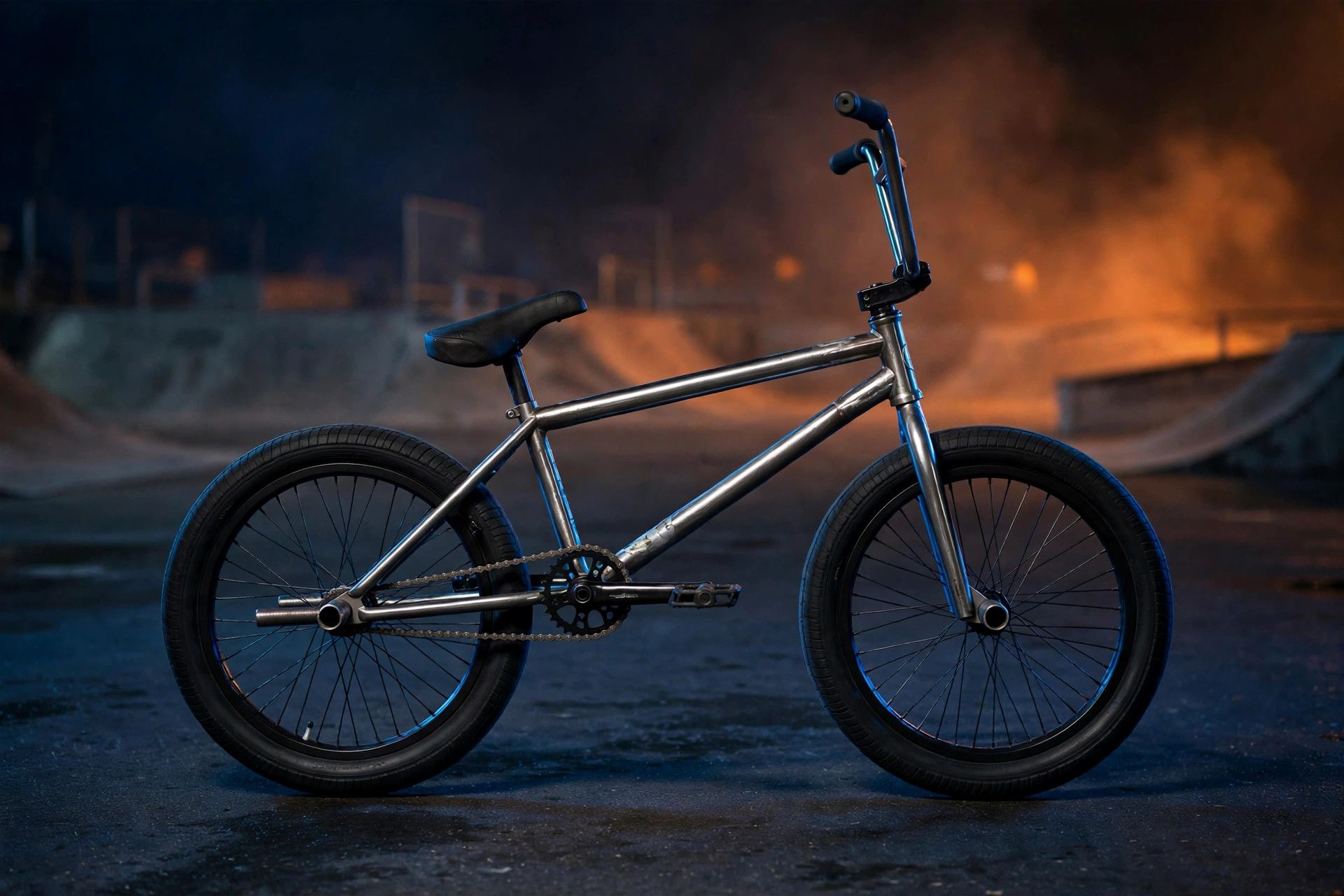
A freestyle frame is described by four numbers, and each one changes something different when you ride. The diagram marks them in the order you check them when buying:
| Measurement | What it changes | Usual range (20" freestyle) |
|---|---|---|
| Top tube | Room to move on the bike: short is nimble and tucked, long is stable and stretched | 20.5" – 21.25" (Sunday Soundwave v3) |
| Chainstay | Pop and manuals: short lifts easily, long gives stability at speed | 13.2" – 13.5" (Soundwave v3); 13.25" the Darkwave, 13.45" – 13.70" the Silvawave |
| Head tube angle | How reactive the steering is: steeper turns sooner, slacker is more forgiving | 75° (Soundwave v3 and Silvawave); 75.25° the Darkwave |
| Bottom bracket height | Where your weight sits: high gives more pedal clearance, low lowers the centre of gravity | 11.5" (Soundwave v3) |
1. Top tube: the frame’s size
On a BMX, the frame size is the top tube: it is measured from the centre of the seat tube to the centre of the head tube, not the length of the tube you can see. It is the measurement that decides whether you ride comfortable or cramped, and once you have bought the frame it cannot be changed: stem and bars fine-tune the position, but they do not fix the wrong size.
| Your height | Top tube |
|---|---|
| 147 – 157 cm | 19.75" – 20.25" |
| 157 – 168 cm | 20" – 20.5" |
| 168 – 175 cm | 20.25" – 20.75" |
| 175 – 183 cm | 20.5" – 21" |
| 183 – 190 cm and up | 20.75" – 21.5" |
For kids, size is decided by the wheel first (12", 14", 16" or 18") and then by the top tube: the BMX for kids guide has the full table by height and age. And if what you want is your first whole bike rather than a bare frame, the best beginner BMX guide compares complete bikes by level.
2. Chainstays: short for tech, long for stability
The chainstays are the tubes joining the bottom bracket to the rear axle, and their length is the measurement you notice most in ground tricks. Short chainstays — around 13.2", like the Soundwave v3 at its most slammed or the Darkwave at 13.25" — bring the rear wheel closer to your body: the bike lifts sooner, manuals come with less effort and turns are quicker. That is what technical street and park want. Long chainstays — 13.45" to 13.70", like the Silvawave — stretch the bike out: more stable at speed, more forgiving on landings and more comfortable on trails and transitions, at the cost of less instant pop.
One practical detail: many modern frames have slotted dropouts, so chainstay length is not a fixed number but a range — the Soundwave v3 runs 13.2" to 13.5" depending on where you set the wheel. Moving the wheel back lengthens the stays and tensions the chain; moving it forwards shortens them. The chain tension guide explains that adjustment.
3. Angles and bottom bracket: how it behaves
The head tube angle is the angle between the head tube and the ground. In freestyle it sits around 75°: the Soundwave v3 and the Silvawave use 75°, the Darkwave 75.25°. Steeper (75.25° or more) is steering that turns the moment you touch it — reactive, precise, demanding; slacker (74° or less) is steering that forgives and tracks straight on its own. To start with, 75° is the reference point: it is what almost every current freestyle frame runs.
The seat tube angle, 71° on the Soundwave v3, sets where the seat sits relative to the bottom bracket and, with it, your position when pedalling. In freestyle you barely notice it — you ride standing almost all the time — but it is the number that tells you whether a frame is built for pedalling (racing) or for tricks.
The bottom bracket height, 11.5" on the Soundwave v3, is the height of the crank axle above the ground. A high bottom bracket leaves more room for the pedals on ledges and ramps; a low one drops your centre of gravity and the bike feels more planted. Like the rest of the geometry, there is no good value and no bad one: there is a balance, and the freestyle reference sits around 11.5".
4130 chromoly or hi-ten: where you feel it
For freestyle frames there are, in practice, two steels. Hi-ten (high-tensile steel, with no chromium or molybdenum) is the entry standard: cheap, tough and heavy, because matching chromoly’s strength needs thicker-walled tubes. It works for learning, for easy riding and for kids’ bikes, where the extra weight matters less. 4130 chromoly — steel with chromium and molybdenum — is far stronger for its weight: it allows thinner, lighter tubes, flexes better with impacts and resists fatigue far longer. It is the standard for serious freestyle, and when it finally gives way it bends before it snaps, which is the warning hi-ten does not always give.
| Material | Who it suits | What you notice |
|---|---|---|
| Full 4130 chromoly | Riders who ride hard: street, park, dirt | Every tube is 4130: lighter, stronger, longer lasting |
| Chromoly front triangle only | Mid-range: good front end, cheaper rear | Chainstays and seatstays are still hi-ten: it shows in lifespan |
| Hi-ten | First bike, kids, easy riding | Heavier, with a shorter life under hard hits; cheap to replace |
| Aluminium | Racing, not freestyle | Light and stiff, but it does not forgive repeated impacts or grinds |
Two quality signals that do not appear in the table: heat treatment — Sunday puts its frames through 41-Thermal, a post-weld treatment — and the warranty: Sunday’s high-end frames carry a lifetime warranty against bending and breaking. Neither replaces the material, but a maker that heat-treats and warrants for life is a maker that trusts its tubing.
Details to check in two minutes
With size and material decided, these five details are checked on the frame’s spec sheet before paying:
- Dropouts. Modern frames have hollow dropouts with integrated chain tensioners, like the Soundwave v3: the wheel sits straight and tensions with no loose parts. Check they take your rear axle — 14 mm in freestyle — and that the pegs you want to run fit them.
- Integrated headset. Almost every modern BMX has one: the bearings drop straight into the head tube, with no cups to press in. If the frame uses another system, the fork and headset have to match that system.
- Mid bottom bracket. It is the modern BMX bottom bracket standard: sealed bearings sit straight in the frame. Other systems (Spanish, American, Euro) still exist, so check your cranks fit the frame’s bottom bracket.
- Removable brakes and gyro tabs. Good frames have removable rear brake mounts and gyro tabs — the Soundwave v3, the Darkwave and the Park Ranger have them: take them off if you ride brakeless or with a gyro and the bike stays clean, put them back if you go back to a brake. A frame with welded-on mounts makes you carry them forever.
- Tyre clearance and standover. The Soundwave v3 takes tyres up to 2.4" at the rear; if you ride a wide tyre, check the clearance before buying. And the standover — the height of the top tube above the ground, 9.25" on the Darkwave and 9.5" on the Silvawave — is what lets you pass the bike between your legs without catching: lower is more comfortable for ground tricks.
Common mistakes when choosing a frame
Do
- Check the dropouts, the integrated headset and removable brake mounts: those are the details you cannot fix later.
- Check compatibility: bottom bracket, headset and rear axle must match what you already own.
- Size by the top tube: almost every adult BMX runs a 20" wheel, but size is the top tube.
Do not
- Buying hi-ten to ride hard: it fatigues sooner and costs more than stepping up to full chromoly.
- Taking "chromoly" at face value: if it does not say "full chromoly" or "100% 4130", the rear triangle is usually hi-ten.
- Ignoring the brakes: welded-on mounts, or none at all, have no cheap fix if you change your mind.
A bare frame or a complete bike?
Starting from zero, a complete with a chromoly frame usually beats building piece by piece: below are completes with serious frames to compare numbers. And if you already have the frame and are building the rest, every part has its own guide with products: stem, bars, saddle, pedals, tyres and chain, plus the multitool to build it all at home.
If the frame is second-hand, the check is the same plus one more: the second-hand buying guide explains how to spot cracks, bends and frames whose warranty is already gone — Sunday’s, for example, only covers the first buyer. And if you do not have a bike yet and the frame is your first step towards a complete, the beginner guide tells you which complete suits your level.
Frequently asked questions
What top tube do I need for my height?
For a 20" wheel: 147–157 cm → 19.75"–20.25"; 157–168 cm → 20"–20.5"; 168–175 cm → 20.25"–20.75"; 175–183 cm → 20.5"–21"; 183 cm and up → 20.75"–21.5". The ranges overlap: if you fall between two, go longer for flow and trails, shorter for technical street and park.
Chromoly or hi-ten?
Full 4130 chromoly if you are going to ride hard: lighter, stronger for its weight and far longer lasting. Hi-ten only pays off to start cheap, for easy riding or on kids’ bikes. Watch the label: “chromoly” on its own can mean just the front triangle; look for “full chromoly” or “100% 4130”.
Are short chainstays better?
It depends on what you ride: short (around 13.2") gives more pop and easier manuals, and long (13.5" or more) gives stability at speed and more forgiving landings. Technical street and park prefer short; trails and transitions prefer long.
What head tube angle should I look for?
In freestyle, 75° is the reference: it is what the Sunday Soundwave v3 and the Silvawave run (the Darkwave, 75.25°). Steeper is more reactive and precise; slacker is more forgiving and stable. To start with, stay at 75°.
Do I need removable brakes?
If you ride brakeless or with a gyro, yes: removable brake mounts and gyro tabs keep the bike clean, and you can put them back on if you ever want a brake. With welded-on mounts you do not get that choice.
Is a second-hand frame worth it?
Yes, if you check it properly: look for cracks at the welds, bends and bent dropouts, and assume the maker’s warranty almost never travels with the bike — Sunday’s only covers the first buyer. The second-hand guide explains the full check.