Buying guide · 9 min
BMX seat: why street riders run it almost on the frame
Pivotal, combo or railed: which post you need, why street riders run it low and six seats and posts on Amazon.es by discipline, with step-by-step fitting.
Guide updated
Quick answer: For street and park, a pivotal seat on a short 25.4 mm post: the KHE MVP Pivotal (262 g) if you want it slim and low, the KHE Pivotal (348 g) or the Demolition Kris Fox Fat if you want more padding to grip with your knees. If your current post is not pivotal, add the 200 mm KHE Pivotal post or go for a combo such as the KHE Affix (seat and post in one, also common in racing). For flatland, the railed KHE Watanabe.
In this guide
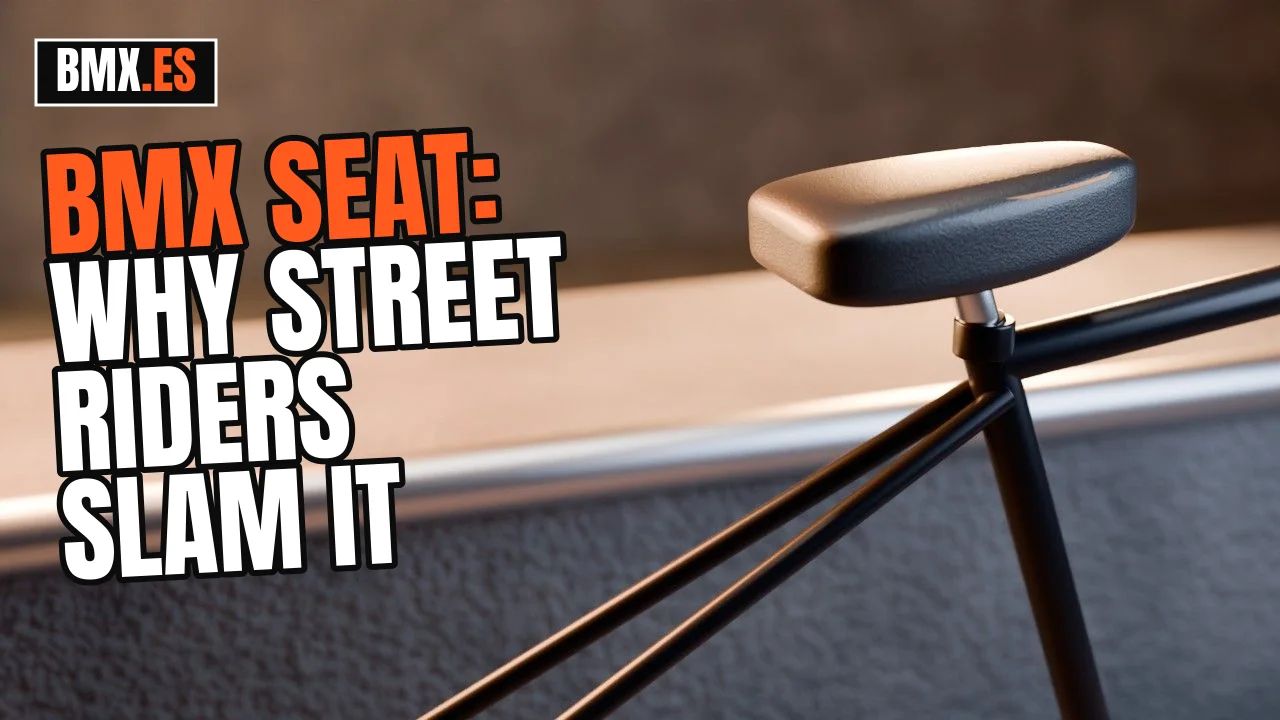
Look around at your next street session: lots of seats are run so low they almost touch the frame. It is not just for looks. In freestyle you pedal and do tricks standing up most of the time, so the seat is there to stay out of the way when you move the bike under you and to be gripped with your knees. That is why a BMX seat is not chosen like the one on a town bike: the mounting system, the post and the thickness matter. Here are six options by discipline, available on Amazon.es on 12 November 2026.
The 6 at a glance
Six options available on Amazon.es on 12 November 2026: four seats, a pivotal post and a combo
262g
KHE
KHE MVP Pivotal (seat)
- Pivotal
- Mid padding
- 230 × 130 mm
ForStreet and park
348g
KHE
KHE Pivotal (padded seat)
- Pivotal
- Fat padding
- 235 × 145 mm
ForStarting out and knee grip
312g
Demolition
Demolition Kris Fox Fat (pivotal seat)
- Pivotal
- Fat
- Kris Fox signature
ForA fat seat from a street brand
138g
KHE
KHE Pivotal post 25.4 × 200 mm
- Pivotal post
- 25.4 × 200 mm
- 7005 aluminium
ForSwitching from railed to pivotal
328g
KHE
KHE Affix Combo Fat (seat + post)
- Combo
- 25.4 × 220 mm post
- Fat padding
ForNo fuss, and racing
266g
KHE
KHE Watanabe (flatland seat)
- Chromoly rails
- No padding
- 188 × 130 mm
ForFlatland
The figure is the weight in grams from each listing (for the combo, seat and post together). Every post is 25.4 mm.
Some links are affiliate links: we may earn a small commission at no extra cost to you. As an Amazon Associate, BMX.es earns from qualifying purchases (Amazon EU Associates Programme).
Pivotal, combo or railed: the first thing to know
According to Dan’s Comp, pivotal is the standard in freestyle, followed by combos; railed seats ruled years ago and are uncommon today. In racing, they say, it is a mix of pivotal and combo. A pivotal seat has a toothed base and is held by a single bolt you tighten from above, through a slot in the seat; a combo is seat and post in one piece, with no angle adjustment but simple and light.
The rule that saves the most money is in the Waller BMX guide: systems do not mix. A pivotal seat needs a pivotal post, a railed seat needs a railed post, and the same goes for Tripod, a less common system. Before buying, check which post your bike has.
What to check, in order of importance
- The system. Pivotal, combo, railed or Tripod. If you change system, you change the post too.
- Post diameter. 25.4 mm is the standard on almost every modern freestyle frame, according to Waller BMX. KHE warns that some aluminium frames take 27.2 mm: check your frame’s spec.
- Post length. Short if you want the seat low; long if you need to raise it, for example for racing, dirt or bigger bikes.
- Thickness. Slim, mid or fat. Waller BMX puts it like this: a slim seat stays out of the way, while mid and fat are easier to grip with your knees during tricks.
- Weight. It comes last: the seats in this guide are less than 90 g apart.
The 6, by discipline
We have not tested them hands-on: we compare what makers and shops publish with what each type of rider needs. The full product cards, with pros and cons, are further down.
1. KHE MVP Pivotal: for street and park
Pivotal, 230 × 130 mm, mid padding and 262 g, the lightest pivotal seat in this guide. KHE describes it as a flat design and recommends it for park, street and dirt. The one to get if you want the seat low and unnoticeable. Against: no post included, and very few reviews on Amazon.es.
2. KHE Pivotal: more padding to grip
Pivotal, 235 × 145 mm, fat padding, faux leather cover and 348 g, according to KHE. It is wider than the MVP, and you feel it when you pinch it with your knees. A good pick if you are starting out or also spend time sitting, for example at the pump track. Against: the heaviest of the six, and no post included either.
3. Demolition Kris Fox Fat: the signature fat seat
Kris Fox’s signature seat for Demolition: pivotal, fat padding, a three-piece faux leather cover with contrast stitching and about 312 g, according to the TBB-Bike shop listing. For riders who want a fat seat from a street brand. Against: Demolition publishes less data than KHE: no dimensions, and the weight comes from a shop listing.
4. KHE Pivotal 200 mm post: the missing piece
If your bike came with a railed seat and you switch to pivotal, you need this. 7005 aluminium, 25.4 mm, 200 mm and 138 g. KHE calls it “very short” and recommends it for park and street, exactly for running the seat low. Against: at 200 mm it does not leave much room to raise the seat; if you are tall or race, it may be too short.
5. KHE Affix Combo Fat: no fuss (and for racing)
A fat-padded seat and a 7005 aluminium post in one piece: 230 × 130 mm, 25.4 mm post, 220 mm long, 328 g in total, according to KHE. You skip matching systems: pull your old post out and put this one in. It fits what Dan’s Comp says about racing, where combos are as common as pivotal seats. Against: you cannot change the angle or swap the seat separately.
6. KHE Watanabe: for flatland
A classic: KHE created it in 2005 for flatland and still sells it as the original. No padding, polypropylene, chromoly rails, 188 × 130 mm and about 266 g, with a shaped underside to grab during tricks. Against: it is railed, so you need a railed post, and with no padding it is not for sitting on.
If you are X, get Y
| If… | Get |
|---|---|
| You ride street or park and want the seat low and slim | KHE MVP Pivotal + KHE Pivotal 200 mm post |
| You are starting out and want something comfy to grip | KHE Pivotal |
| You want a signature fat seat | Demolition Kris Fox Fat |
| Your bike has a railed post and you do not want to think about compatibility | KHE Affix Combo Fat |
| You race on a track | KHE Affix Combo Fat (check that a 220 mm post gives you the height) |
| You ride flatland | KHE Watanabe + a railed post |
With the seat low, knee-grip tricks come sooner: try the barspin or the tailwhip. And if you want to try heights before buying, ask someone at your park to lend you their bike: use the skatepark and track directory.
How to fit a pivotal seat, step by step
- Put a little grease on the seat bolt.
- Bolt the seat to the post with a 6 mm Allen key through the top slot, according to Source BMX.
- Put the post in the frame at your height, line the seat up with the bike and tighten the clamp. Source BMX says to keep at least 2–3″ (5–7.5 cm) of post inside the frame; your post usually has a mark.
- Set the angle: loosen the seat bolt, position it how you like and tighten again.
Before you ride
Recheck both bolts after your first session. KHE says not to use a loose or damaged seat and to replace it if it has cracks or bent rails.
What about a railed seat on a pivotal post, with some adapter?
The Waller BMX advice is simple: each seat with a post of its own system. If you want to try a different system, the most direct way is a combo, which comes with its own post.
Common mistakes
- Buying a pivotal seat and finding out your post is railed.
- Ordering a 25.4 mm post for a 27.2 mm frame (or the other way round).
- Pulling the post above the minimum insertion mark to gain height.
- Cutting the post without knowing how much has to stay inside the frame.
- Leaving the seat crooked relative to the bike: you notice it when you grip it with your knees.
For the rest of the bike, see the first upgrades guide, the handlebars guide and all our buying guides.
Frequently asked questions
Which BMX seat is better, pivotal or railed?
For freestyle, pivotal: according to Dan’s Comp it is the standard, because it adjusts the angle with a single bolt and keeps things clean and light. Railed seats are uncommon today, except for flatland, old-school builds or riders who also want fore-aft adjustment.
What seat post diameter does a BMX use?
Almost every modern freestyle frame uses 25.4 mm, according to Waller BMX. KHE warns that some aluminium frames take 27.2 mm, so check your frame’s spec before buying.
Can I put a pivotal seat on my railed post?
No. Each seat needs a post of its own system. If you switch to pivotal, buy a pivotal post too; or choose a combo, which comes as seat and post in one piece.
Why do street riders run their seats so low?
Because in freestyle you ride standing up most of the time: low down, the seat stays out of the way when you move the bike and you can grip it with your knees. Waller BMX recommends short posts to run it low; KHE sells its 200 mm post for park and street.
How much post has to stay inside the frame?
Never above your post’s minimum insertion mark. Source BMX gives at least 2–3″ (5–7.5 cm) inside the frame as a guide.