Buying guide · 9 min
BMX stem: 27 mm more bar height without new bars
Top load or front load: what changes, how much your bars go up and four 50 mm stems available on Amazon.es, with fit checks and fitting.
Guide updated
Quick answer: Top load if you want higher bars and a more upright stance; front load if you want them low with a compact front end. The difference is real: the Eastern Throttle stems, with the same reach and stack, have 32 mm and 5 mm of rise. For top load, the KHE Freestyle (264 g) or the Eastern Throttle Top Load; for front load, the KHE Frontloader (232 g) or the Eastern Throttle Front Load. First check for a 1 1/8″ steerer and a 22.2 mm bar.
In this guide
It happens at every skatepark: a friend swaps only the stem and, when you try their bike, the bars feel higher even though they are the same ones. It is not your imagination. Between a front-load and a top-load stem from the same family there can be 27 mm of height: a little over an inch, almost what separates an 8.75″ bar from a 9.75″ one. The BMX stem is small, but it decides where your hands sit. Here are four, available on Amazon.es on 11 November 2026: two top loads and two front loads.
The 4 stems at a glance
Four stems available on Amazon.es on 11 November 2026: two top loads and two front loads
264g
KHE
KHE Freestyle aluminium 50 mm (top-load stem)
- Top load
- 7005 aluminium
- Fits 18″ bikes
ForA light top load
275g
Eastern Bikes
Eastern Throttle Top Load (stem)
- Top load
- 32 mm rise
- Forged 6061
ForRaising your bars
232g
KHE
KHE Frontloader aluminium 50 mm (front-load stem)
- Front load
- 7005 aluminium
- Cut-out body
ForA low, light front end
275g
Eastern Bikes
Eastern Throttle Front Load (stem)
- Front load
- 5 mm rise
- Forged 6061
ForLowering your bars
The figure is the weight in grams from each listing. All four have 50 mm reach, a 1 1/8″ steerer and a 22.2 mm clamp.
Some links are affiliate links: we may earn a small commission at no extra cost to you. As an Amazon Associate, BMX.es earns from qualifying purchases (Amazon EU Associates Programme).
Top load or front load: what really changes
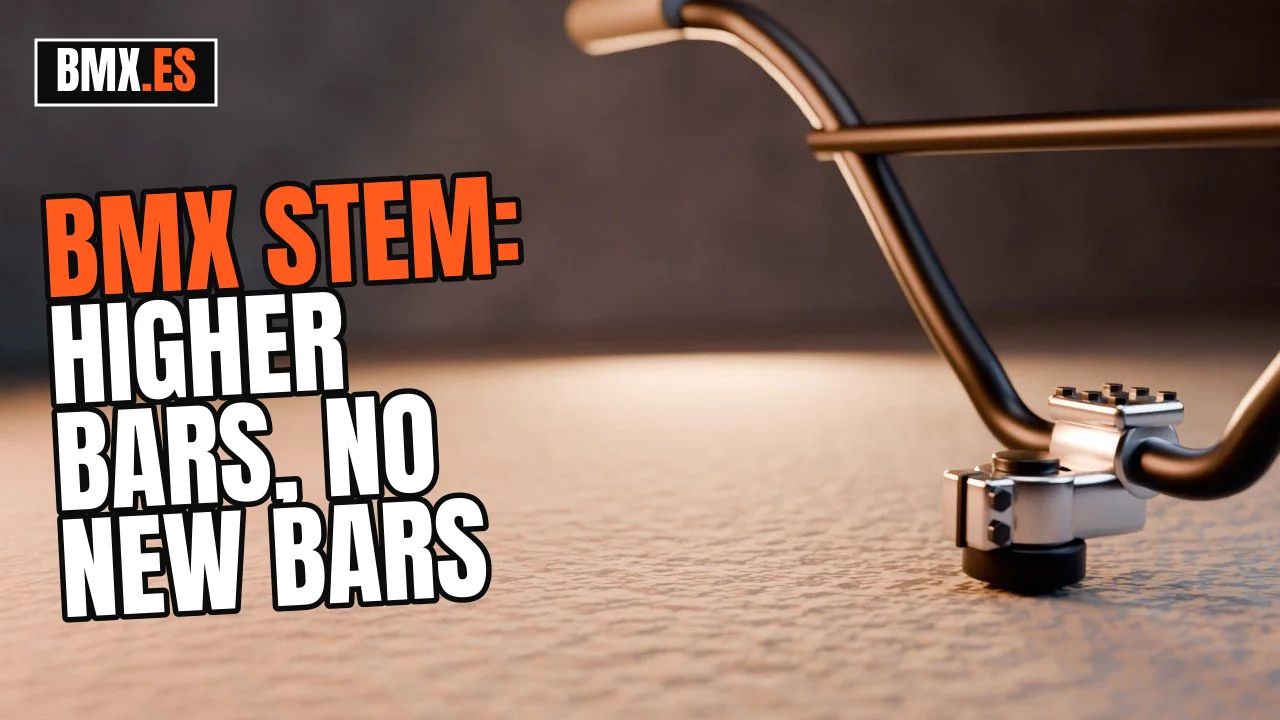
On a top load the bar sits on top of the body and a cap clamps it from above; on a front load it sits in front and the faceplate bolts to the front. According to Dan’s Comp, a front load keeps the bar lower and feels more stable and race-like; a top load raises it and puts you in a more upright, responsive position. KHE says much the same: top loads suit taller riders and flatland; front loads keep the bar low for technical tricks.
Dan’s Comp gives typical ranges: about 20–35 mm of rise on a top load and 8–10 mm on a front load. The Eastern Throttle stems fit that: 32 mm for the top load and 5 mm for the front load, with the same reach (50 mm) and the same stack (30 mm). That makes them the best pair to see the difference: only the way the bar is clamped changes.
What to check, in order of importance
- That it fits your fork. Modern freestyle is always 1 1/8″ threadless, according to Dan’s Comp. If your bike is a basic one with a threaded 1″ fork, you need a quill stem, as Park Tool explains: none of these four.
- The bar clamp. 22.2 mm (7/8″) is the standard and all four use it. In racing there are 28.6 and 31.8 mm bars that need a matching stem.
- The type: top or front. It changes bar height more than anything else without touching other parts.
- Reach. From the steerer centre to the bar centre. 45–55 mm is common in freestyle and all four are 50 mm. Dan’s Comp advises changing only a couple of millimetres from what you ride, because it is very noticeable.
- Stack. The height of the part that clamps the steerer. If the new stem is taller or shorter than the old one, you will need to move spacers.
The 4 BMX stems, one by one
We have not tested them hands-on: we compare what makers and shops publish with what each type of rider needs. The full product cards, with pros and cons, are further down.
1. KHE Freestyle 50 mm: the light top load
7005 aluminium, 50 mm reach, 30 mm height and 264 g, for a 1 1/8″ steerer and a 22.2 mm bar, according to KHE, which also rates it for 18″ bikes. It is one of the few listings that gives torque values: 6–8 Nm on the bar clamp and 10–12 Nm on the steerer. Against: KHE does not list the rise separately, so you do not know exactly how much it lifts the bar.
2. Eastern Throttle Top Load: the one that lifts 32 mm
Forged 6061 aluminium, chromoly bolts, 50 mm reach, 32 mm rise and 30 mm stack, with a recessed top to hide the compression bolt, according to Eastern Bikes. About 275 g. The pick if you want clearly higher bars without changing them. Against: about 10 g more than the KHE, and Eastern pitches it at young riders.
3. KHE Frontloader 50 mm: the lightest
7005 aluminium with weight-saving cut-outs, 50 mm reach, 30 mm height and 232 g, for 1 1/8″ and 22.2 mm, according to KHE. For a low, light front end for street. Against: a recent listing on Amazon.es with very few reviews, and the rise is not listed either.
4. Eastern Throttle Front Load: the bar almost level
The twin of number 2: the same forged 6061 aluminium, the same 50 mm reach and 30 mm stack, but only 5 mm of rise and rounded, knee-friendly edges, according to Eastern Bikes. Against: about 40 g heavier than the KHE Frontloader.
If you are X, get Y
| If… | Get |
|---|---|
| You ride hunched and want higher bars without changing them | Eastern Throttle Top Load |
| You want the lightest possible top load | KHE Freestyle 50 mm |
| You ride technical street and want a low front end | KHE Frontloader 50 mm |
| You want to drop about 27 mm from your current top load | Eastern Throttle Front Load |
| Your bike is an 18″ | KHE Freestyle 50 mm (KHE rates it for 18″) |
| Your fork is a threaded 1″ | None: you need a quill stem |
If what you really need is height, see our BMX handlebars guide too, with a rise chart by rider height. And before buying, try the bike of someone at your park who runs the other type of stem: use the skatepark and track directory.
How to change your stem, step by step
- Remove the bars (support them so the brake cable does not kink), loosen the side bolts and take off the top cap.
- Fit the new stem and spacers: according to Park Tool, they should sit about 3 mm above the top of the steerer; if they are flush or below, the headset cannot be adjusted.
- Adjust the headset with the top cap: no play, but the bars should turn freely.
- Line up the stem with the wheel and tighten the side bolts.
- Fit the bars centred and tighten the bolts crosswise to the maker’s torque: KHE gives 6–8 Nm for the bar clamp and 10–12 Nm for the steerer clamp on the Freestyle.
Before you ride
Recheck the bolts after your first session and after any hard crash. If you see cracks or deformation on the stem, KHE says to replace it immediately; it does not allow drilling or cutting it either.
Can I raise my bars with spacers instead of a new stem?
A little, yes: moving spacers from above to below the stem raises the bar, as Park Tool explains. But BMX forks are usually cut short, and you always need those 3 mm above the steerer. If there is no room left, the way to go is a top load with more rise or a taller bar.
Common mistakes
- Buying a 1 1/8″ stem for a threaded 1″ fork.
- Fitting it without checking the stack and losing the 3 mm above the steerer.
- Tightening the side bolts before adjusting the headset.
- Fully tightening one bar bolt and then the others, instead of crosswise.
- Jumping from 50 to 60 mm of reach in one go: millimetres are noticeable.
With your front end dialled, your manual and bunny hop will feel different: give it a couple of sessions. For the rest of the bike, see the first upgrades guide and all our buying guides.
Frequently asked questions
What is the difference between a top-load and a front-load stem?
On a top load the bar is clamped from above and sits higher; on a front load it is clamped at the front and sits lower. Dan’s Comp gives about 20–35 mm of rise for top loads and 8–10 mm for front loads.
What stem size does my BMX need?
Check two things: the fork (modern freestyle uses 1 1/8″ threadless) and the bar clamp (22.2 mm is normal). All four stems in this guide are 1 1/8″ and 22.2 mm.
What is a normal BMX stem reach?
In freestyle it is usually between 45 and 55 mm, according to Dan’s Comp. All four in this guide are 50 mm. If you change, do it by a few millimetres.
How much does a top-load stem raise the bars?
It depends on the model. With the Eastern Throttle stems, which share reach and stack, the top load has 32 mm of rise and the front load 5 mm: about 27 mm of difference.
What torque should stem bolts be tightened to?
Whatever the maker specifies. KHE gives 6–8 Nm for the bar clamp and 10–12 Nm for the steerer clamp on its Freestyle stem, always crosswise.